High Security Turnstile: Types, Benefits & Buyer’s Guide
A high security turnstile is a physical barrier engineered to stop unauthorised entry, tailgating, and forced intrusion at critical access points — data centres, banks, defence facilities, and government buildings. Unlike a standard tripod turnstile that manages traffic flow, a high security turnstile is built to physically resist climbing, crawling, and piggybacking, often withstanding significant impact force.
How a High Security Turnstile Works
The barrier combines full-height or optical sensing with a rigid physical obstruction. A credential — biometric scan, RFID card, or facial recognition — authorises one person. Infrared sensors detect body mass and motion to catch tailgating attempts in real time. If an unauthorised second entry is detected, the turnstile locks and triggers an alarm before the barrier arm ever fully retracts.
Types of High Security Turnstiles
- Full-Height Turnstiles: Floor-to-ceiling rotating barriers used at unmanned or perimeter entrances where climbing is a real risk.
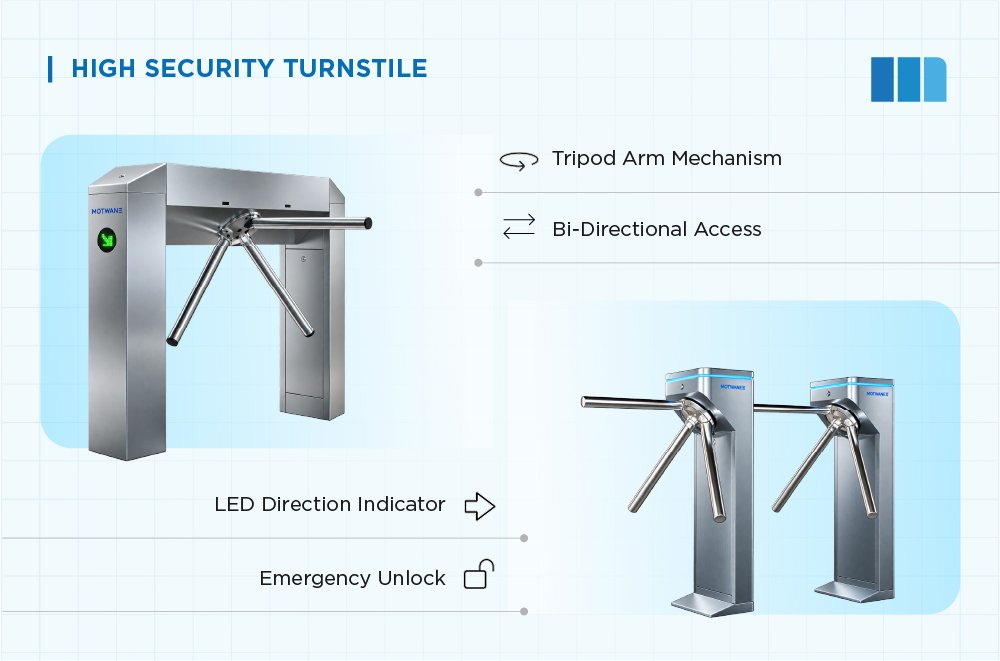
- Tripod Turnstile Slim: A tripod turnstile is a compact and durable access control device designed to regulate the flow of individuals in restricted areas
- Tripod Turnstile Elegant: combines functionality with sophistication, offering a sleek and stylish solution for managing access control. Its refined design seamlessly integrates with modern architectural aesthetics while providing robust security.
- Rotary security gates: Heavy rotating barriers for outdoor perimeter and industrial plant boundaries.
Benefits of High Security Turnstiles
They physically stop tailgating rather than just recording it, which is the biggest gap in standard access control. Integration with biometrics removes card-sharing risk entirely. Alarm-linked sensors alert security staff the moment an intrusion attempt happens, not after review. And because the barrier itself is the deterrent, high security turnstiles reduce dependency on manned guarding at critical points.
FAQ: How to Choose a High Security Turnstile
Match the barrier to the threat: full-height turnstiles suit unmanned perimeters; mantraps suit rooms holding servers, cash, or classified material. Check the anti-tailgating sensor’s detection accuracy — ask for the false-reject and false-accept rate, not marketing language. Confirm construction rating (IP rating for outdoor units, impact resistance for forced-entry risk). Verify fail-safe vs fail-secure behaviour against your fire code.
FAQ: What makes a turnstile “high security” compared to a standard turnstile?
A standard tripod turnstile manages traffic flow but can often be climbed over or crawled under. A high security turnstile adds physical resistance — full-height barriers, interlocking doors, or dense infrared sensor arrays — combined with real-time tailgating detection that locks the unit and triggers an alarm the moment an unauthorised second entry is attempted.
FAQ: Which is better for a data centre — a mantrap or a full-height turnstile?
A mantrap is generally the better fit for a data centre or server room, since its interlocking dual-door design guarantees exactly one person is sealed inside before verification completes. Full-height turnstiles are better suited to unmanned outdoor perimeters where the main risk is someone climbing over, rather than tailgating a colleague through an indoor doorway.